
Hurricane and Storm Damage to Structural Steel in Houston - What Happens to Your I-Beams
A storm doesn’t have to destroy your building to destroy its structural integrity. A Category 1 hurricane. A line of severe thunderstorms. A tornado touching down three miles from your facility. Any one of those events can bend, crack, or buckle the I-beams carrying your roof and you might not see the damage from the ground. This guide explains exactly what happens to structural steel during a storm, why Houston’s threat environment is one of the toughest in the country, and what storm damage I-beam repair in Houston TX looks like when it’s done correctly.
Why Houston Buildings Face Extreme Storm Risk
Houston sits at the intersection of two serious storm threats. To the south, the Gulf of Mexico feeds warm, humid air into the region year-round — and that same Gulf is the energy source for Atlantic hurricanes that track inland through Harris County. To the north and west, cold Canadian air masses collide with Gulf moisture to produce the kind of severe thunderstorm lines that spawn tornadoes, straight-line winds, and baseball-sized hail.
The numbers tell the story plainly. Houston’s minimum design wind load under the Texas IBC is 120 MPH — meaning every commercial and industrial building in Harris County is engineered to survive a Category 2 hurricane’s sustained winds. But actual storm events regularly exceed that. Hurricane Harvey in 2017 brought sustained winds of 130 MPH and catastrophic flooding. The May 2024 tornado that struck the greater Houston area caused structural damage across multiple neighborhoods in under 20 minutes.
That means even a well-built, well-maintained building can take structural steel hits in a bad storm. And the damage isn’t always obvious when you walk through afterward.
What Storms Actually Do to I-Beams - Force by Force
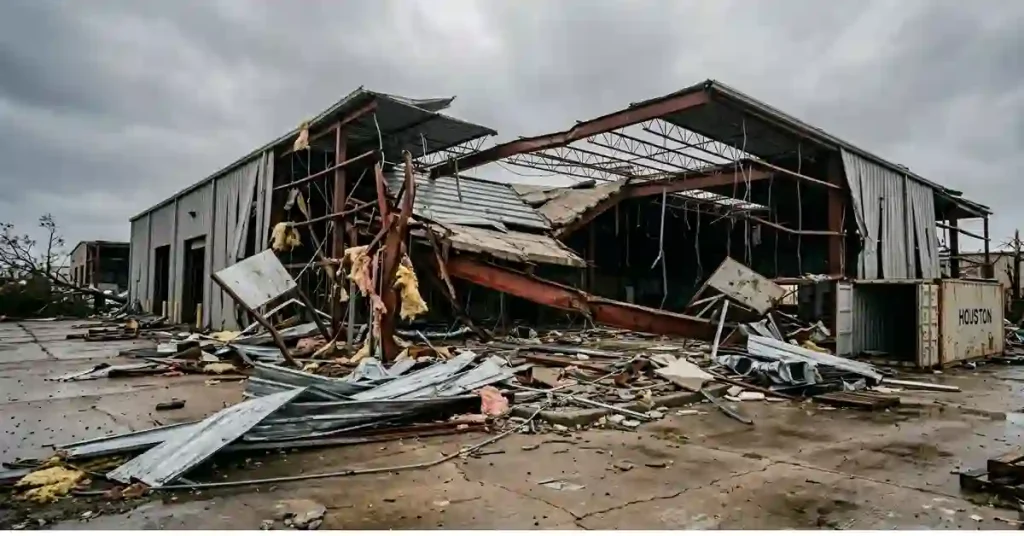
Wind Pressure: How It Loads a Structural Frame
Most people think of wind as a simple lateral push. Structurally, it’s far more complex than that. When a storm wind hits a building, it creates:
Positive pressure on the windward wall — pushing inward against the wall panels and the columns behind them.
Negative pressure (suction) on the leeward wall and roof — pulling outward, lifting panels, and putting uplift tension on roof beams and their connections.
Corner vortex loads at building corners and roof edges — often the highest pressures in the entire wind field, and the zones where flange separations and weld failures happen first.
A wide-flange I-beam spanning a warehouse roof is designed to handle these forces within specific limits. When a storm drives pressure beyond those limits — or when the beam is already weakened by corrosion or a previous impact — it can deflect past its elastic range into permanent deformation. That means it won’t spring back when the wind drops. It stays bent. And it stays at reduced load capacity for every storm that comes after.
Flying Debris Impact: The Damage Nobody Expects
High-wind events don’t just push air. They carry objects — tree limbs, roofing panels, metal signs, HVAC equipment — at speeds that make them genuine projectiles. A piece of corrugated metal roofing traveling at 80 MPH carries enough kinetic energy to dent a beam flange, sever a weld, or crack the web at a connection zone.
This type of storm damage I-beam repair in Houston TX is particularly tricky because debris impact damage is often localized. The visible damage to the exterior cladding draws your attention, but the impact transferred energy through the wall panel into the structural frame behind it. We find connection failures and flange deformations on beams that look unaffected from the outside — they’re only visible when you get eyes on the steel directly.
Flood Loading: The Structural Damage Harvey Left Behind
Hurricane Harvey didn’t just blow things down. It sat over Greater Houston for four days, dropped over 50 inches of rain in some areas, and flooded thousands of commercial and industrial buildings. That flooding created structural problems that are still being discovered and repaired today.
Here’s what flood water does to structural steel frames:
Hydrostatic pressure on walls — a column of water pressing against a wall panel transfers lateral load into the columns and horizontal beams at that level. At high water levels, that load exceeds design assumptions.
Foundation movement — saturated soils behave differently than dry ones. Houston’s expansive black clay soil, already prone to swelling and shrinking, becomes nearly unstable when flooded. That foundation movement stresses beam-to-column base connections, sometimes causing weld cracking that stays hidden under water line staining.
Accelerated corrosion — flood water, especially in Harris County’s industrial corridors, often carries chemicals, petroleum products, and sediment. That contamination accelerates corrosion on any steel it contacts, destroying coating systems and attacking base metal directly. A beam that went into Harvey in good condition could come out with active corrosion that wasn’t there before.
Moreover, many post-Harvey cleanup and repair jobs were done quickly to get buildings back in operation — and not all of them were done to AISC 360 standard. We’ve inspected buildings four and five years after Harvey and found patch welds that were never load-rated, connections that were re-fastened but not re-engineered, and corrosion that was painted over rather than remediated. That deferred damage is now catching up with building owners across the region.
The May 2024 Tornado — What We Saw on the Ground
Krassy D. left us a Google review after the May 2024 tornado: “Sam and the team repaired our tornado-damaged structure from top to bottom. Steel frame, roof panels, everything. Fast, professional, and done right. These guys are the real deal for structural work in Houston.”
That job — like most tornado damage jobs we handle — involved a combination of damage types in a single building. The tornado’s rotating winds created simultaneous positive and negative pressure on opposite faces of the structure, which means beams were being pulled in two directions at once. Some connections failed in tension; others buckled in compression. The roof was partially lifted on one side, which transferred uplift into the ridge beams and caused weld separation at the peak connections.
A contractor looking only at the visible damage — missing panels, deformed roof — would have missed half the structural damage. We found cracked welds at three beam-to-column connections that showed no exterior sign of failure. Those would have been the first things to let go in the next significant wind event.
That’s why thorough post-storm structural inspection matters as much as the repair itself.
What Storm Damage I-Beam Repair in Houston TX Actually Involves
Step 1 — Structural Assessment Before Any Repair
The first thing we do after a storm call isn’t pick up a welder. It’s document. Every beam gets photographed, deflection is measured against AISC 360 limits, weld connections are inspected at each face, and the full load path is traced from beam to column to foundation. This assessment produces the evidence base for your insurance claim and the scope document for our repair work.
We’ve helped clients recover tens of thousands of dollars in insurance settlements by providing comprehensive structural documentation that adjusters couldn’t dispute. General contractors who skip the full assessment often leave recoverable money on the table — and leave hidden damage in the structure.
Step 2 — Temporary Shoring Where Needed
If a primary load-carrying beam has deflected significantly or a connection has failed, we install temporary shoring before any repair work starts.
This protects the building and everyone in it during the repair process.
It’s a non-negotiable step that some less experienced contractors skip to save time. We don’t.
Step 3 — Repair, Reinforce, or Replace — With Engineering Behind Each Decision
Every storm-damaged I-beam gets the same engineering question: can this member be restored to full rated capacity through repair, or does it need replacement? The answer depends on deflection extent, section loss, weld failure location, and whether the base metal has fractured.
Beams with deformed flanges but intact webs and no fracture can often be straightened using hydraulic jacking and reinforced with cover plates or gusset plates per AISC 360. Beams with fractured webs, separated connections, or section loss greater than 20% typically need partial or full replacement. We use ASTM A572 Grade 50 steel for all replacement members — it matches or exceeds the yield strength of most original building steel and is the current standard for structural wide-flange sections.
Step 4 — AWS D1.1 Welding and Documentation
All welding on storm damage I-beam repair work is performed to AWS D1.1 structural welding code by our certified welders. We document weld procedure specifications, filler metal classifications, and inspection results. That paperwork is part of your file — it matters for insurance closeout, future inspections, and resale of the property.
For full details on our repair process and the types of beam damage we handle, see our I-beam repair in Houston service page. If your building sustained broader storm damage beyond structural steel, our storm damage repair page covers the full scope of what we handle after a major weather event. And for buildings with multiple beam types damaged in the same event, our steel beam repair in Houston page walks through HSS sections, plate girders, and wide-flange work we perform beyond standard I-beams.
Storm Damage I-Beam Risks Specific to Houston Suburbs
Harris County’s industrial belt — Pasadena TX 77506, Baytown TX 77520, and the Ship Channel corridor — takes the hardest structural steel hits in the metro because of the concentration of large clear-span warehouses and manufacturing facilities with wide-flange primary frames. These buildings have spans of 100 to 300 feet, and their primary I-beams are carrying serious loads. A 10-degree deflection in a W36 primary rafter isn’t a maintenance issue — it’s a structural emergency.
In the north suburbs — Conroe TX 77301, Tomball TX 77375, Humble TX 77338, and Spring TX 77373 — tornado risk is actually higher than in central Houston because these areas sit in the transition zone between Gulf moisture and dry continental air. That’s where the strongest rotating storms tend to develop. We’ve handled post-tornado work in these areas multiple times in the past three years alone.
The Woodlands TX 77380, Katy TX 77449, and Sugar Land TX 77478 all experienced significant wind damage during recent storm seasons. Pre-engineered metal buildings and barndominiums in those suburbs are particularly vulnerable because their primary frames are designed to tight tolerances — small deflections that wouldn’t matter in an overbuilt structure can push a metal building frame outside its design envelope.
When to Call After a Storm — and When It's Urgent
Call immediately — same day, including nights and weekends — if:
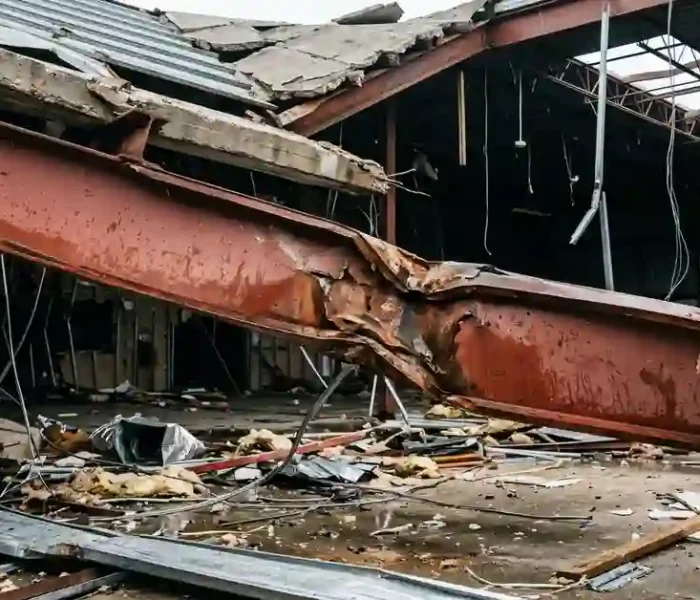
- You can see a visible sag or bow in a roof beam from inside the building
- A wall has shifted or appears to be leaning inward or outward
- Any weld connection is visibly separated or cracked
- The roofline has changed shape compared to before the storm
- You hear unusual creaking or cracking sounds from the frame
Schedule within 48 hours if:
- The building appears intact but was in the storm’s direct path
- There is visible damage to exterior cladding or roof panels (panel damage often conceals beam damage behind it)
- Doors or windows that previously operated smoothly are now binding or racking
Annual post-storm inspection is the right standard for any Greater Houston building more than 10 years old, or any building that has been through two or more significant weather events without a full structural assessment.
We respond 24 hours a day, 7 days a week for structural emergencies across all of Harris County and Greater Houston. Call (832) 506-1574) any time after a storm event and you’ll reach a real person — not an answering service.
Frequently Asked Questions
Does homeowner's or commercial property insurance cover storm damage to I-beams in Houston?
In most cases, yes — storm damage to structural steel is a covered peril under standard commercial property policies. The key is documentation. Insurance adjusters need photographic evidence, deflection measurements, and a written scope of damage tied to the storm event. We provide all of that as part of our post-storm assessment, and we’ve worked directly with adjusters on hundreds of Harris County storm claims. The more complete your documentation, the stronger your claim.
How quickly do you respond to storm damage calls in Houston TX?
We respond same day to emergency structural calls across Greater Houston and Harris County — 24 hours a day, 7 days a week. For post-storm situations where the building isn’t in immediate danger, we schedule non-emergency inspections within 24–48 hours. Our response area covers all Houston ZIP codes (77001–77099), Katy TX, Sugar Land TX, The Woodlands TX, Pearland TX, Pasadena TX, Baytown TX, Conroe TX, Humble TX, Spring TX, Tomball TX, Cypress TX, League City TX, Richmond TX, and Rosenberg TX.
Can storm-damaged I-beams be repaired without full replacement?
Yes — in many cases. If the beam has deflected but not fractured, and if section loss from either the storm or pre-existing corrosion is below 20%, we can often straighten and reinforce the member rather than replace it. Repair typically costs 30–60% less than full replacement and can be completed faster, which matters for buildings that are shut down or exposed after a storm. We run the engineering analysis on every beam individually and give you an honest answer either way.
How do I know if my building's I-beams were damaged if the structure looks intact?
That’s the hardest part of post-storm structural assessment — damage to steel frames is often invisible from inside a building. Weld failures, flange deformations, and web buckling at connection zones can all occur without visible exterior changes. The reliable answer is a professional structural inspection using deflection measurement tools and direct visual access to beam surfaces and connections. Don’t assume intact cladding means intact structure.
What's the minimum wind speed that can damage structural I-beams in Houston?
Properly designed and maintained beams won’t fail in winds up to their design load — typically 120 MPH for Houston area buildings. However, beams already weakened by corrosion, previous impacts, or weld fatigue can fail at much lower wind speeds. We’ve seen beam connection failures in buildings exposed to 65–75 MPH gusts when the steel had existing section loss from corrosion. That’s why post-storm inspection matters even after what appears to be a minor wind event.
Free Post-Storm Structural Inspection — Call Now
If your building was in the path of any recent Houston area storm, don’t wait to find out whether your I-beams are still structurally sound. We provide free on-site assessments across all of Greater Houston and Harris County, and we respond same day for urgent situations.
Call (832) 506-1574 — available 24/7, including nights and weekends after major storm events. Or email estimate@houstonbuildingrepair.com with your address and a brief description of the event.
Houston Building Repair Company — licensed and insured in Texas, 5.0 Google rating, 500+ structural repair projects completed, 25+ years serving the Houston metro.