
How to Tell If Your Building's I-Beam Is Damaged (Houston Owner's Guide)
Steel doesn’t lie but it doesn’t always shout, either. A failing I-beam can quietly lose strength for months before it shows an obvious crack. By then, the repair scope and the cost has grown. Knowing the signs of I-beam damage in Houston buildings puts you ahead of the problem. This guide covers six warning signs every Houston property owner should know, plus why Gulf Coast conditions make beam damage here worse than almost anywhere else in the country.
Why I-Beam Damage Signs in Houston Are Easy to Miss
An I-beam named for the cross-sectional shape of the letter “I” carries your building’s roof load, floor load, or both across an open span. The top and bottom horizontal plates are called flanges. The vertical plate between them is the web. When any part of that cross-section is compromised, the beam’s load capacity drops. The problem is, a beam can lose 15–20% of its effective section area before you notice anything with the naked eye.
That’s especially dangerous in Houston. Our Gulf Coast humidity, expansive black clay soil, and history of severe storms create stressors that age structural steel faster than in most other American cities. So that means a beam that looks fine from the floor may already be working harder than it should.
The good news: there are reliable warning signs. You just need to know what to look for.
6 Warning Signs of I-Beam Damage in Houston Buildings
Sign 1: Visible Sag or Bow Along the Beam's Span
This is the most direct sign and the one most people spot only after the damage is already serious. Stand at one end of a beam and sight down its length. A healthy beam should appear perfectly straight. Any downward curve in the middle, or a sideways bow in the web, means the beam has deflected beyond its design limits.
AISC 360 sets maximum allowable deflection at L/360 for floor beams (where L is the span length in inches). A 20-foot beam, therefore, should never deflect more than two-thirds of an inch under full load. If you can see a bow with the naked eye, you’re likely well past that threshold. Don’t wait on this one call for an inspection the same day.
Sign 2: Rust Staining and Surface Corrosion
Orange streaking down a wall below a beam connection, or red-brown surface scale on the beam itself, is an early warning you shouldn’t ignore. Corrosion on the surface is visible; section loss beneath it isn’t. Houston’s Gulf Coast humidity regularly exceeds 90% for months at a time, and with 50 inches of annual rainfall, unprotected steel corrodes faster here than almost anywhere else in the continental U.S.
Furthermore, active pitting corrosion the kind that eats into the web and flanges rather than just coating the surface can reduce cross-sectional area by 10–15% before it shows through a paint coating. We’ve seen beams in Harris County warehouses with 25–40% section loss in structures only 20–30 years old. That kind of damage doesn’t announce itself loudly. It just quietly fails.
Sign 3: Cracked, Broken, or Separated Welds at Connections
Weld connections are where beams attach to columns, end plates, and other structural members. These connection points carry enormous stress concentrations, especially during wind events and foundation movement. A cracked weld looks like a thin dark hairline at the junction between the beam flange and its connection plate. In some cases you’ll see a visible gap, or the two pieces will appear slightly separated.
Weld fatigue is one of the most common signs of I-beam damage in Houston industrial buildings, particularly in facilities near Pasadena TX 77506 and Baytown TX 77520 where forklift traffic and heavy equipment vibration cycle-load connection points constantly. Cracked welds must be properly ground, prepped, and re-welded to AWS D1.1 standards not patched over with filler.
Sign 4: Roofline Distortion or Uneven Floors Above
If your building’s roofline has developed a visible dip or ridge where it used to be flat, that’s a structural red flag. Similarly, if a floor above a clear-span area has become noticeably bouncy, springy, or uneven, the beam below it is likely deflecting under load.
These symptoms often appear gradually over months or years, so they’re easy to dismiss as “always been like that.” But roofline distortion and floor bounce are both textbook signs of structural I-beam damage they mean the member carrying that section of the building is no longer performing as designed. Houston’s expansive black clay soil makes this worse: cyclic swelling and shrinking puts lateral stress on connections that can accelerate beam deflection over time.
Sign 5: Doors and Windows That Suddenly Won't Close Properly
This one surprises people. A door that sticks or a window that’s racking in its frame can sometimes trace back to a structural beam, not just seasonal wood movement. When a beam deflects, it changes the geometry of the frame it supports. That change propagates into partitions, door frames, and window openings causing them to go out of square.
In commercial and industrial buildings across Greater Houston, this symptom often shows up near a beam that’s been impacted by a forklift or is corroding near a roof penetration. It’s not always the cause, but it’s worth investigating alongside the beam above. As a result, we always inspect the connected structural members whenever we’re called for a door or window alignment problem in a metal or steel-frame building.
Sign 6: Unusual Sounds — Creaking, Popping, or Cracking Under Load
Steel structures make noise — that’s normal expansion and contraction from thermal cycles. But sharp cracking sounds, especially during wind events or when heavy equipment moves across a floor, are not normal. A single loud pop from a weld zone can mean a connection has partially failed. Persistent creaking under load can indicate a beam deflecting beyond its elastic range.
Krassy D. left a Google review after the May 2024 tornado that hit her area: she described extensive roof and structural damage she didn’t fully understand until our team walked her through the findings. That’s exactly the situation — building owners hear something alarming, aren’t sure what it means, and need a professional to assess it clearly and honestly. If your building makes sounds it didn’t used to make, that’s one of the more urgent signs of I-beam damage in Houston worth acting on immediately.
Why Houston Buildings Are Especially Vulnerable
Houston is tough on structural steel in ways that other cities simply aren’t.
Gulf Coast humidity stays above 70–90% for most of the year. Combined with 50 inches of annual rainfall, that’s a relentless corrosion environment for any steel that isn’t properly coated and maintained. We routinely find beam corrosion in Houston buildings that were protected at construction but never re-coated and in our climate, that neglect compounds quickly.
Houston’s expansive black clay soil sometimes called Houston Black — swells when wet and shrinks when dry. That seasonal movement creates differential settlement under building foundations, which translates into torsional stress on steel frames. Over years, this stresses weld connections at column bases and beam ends, causing the slow-building fatigue cracks we described above.
Hurricane Harvey in 2017 caused widespread structural damage across Harris County that’s still being discovered and repaired today. Flooding weakened coating systems and accelerated corrosion; wind loads bent flanges on already-compromised beams. Moreover, many post-Harvey repairs were done quickly and informally we’ve found substandard patch welds and improperly installed gusset plates on jobs we were called to inspect years later.
Forklift and vehicle strikes are the number-one mechanical cause of I-beam damage we see in Houston industrial and warehouse facilities — from the Ship Channel to the North Belt to the distribution corridors in Humble TX 77338 and Spring TX 77373. A loaded forklift hitting a column base at 5 MPH can permanently deform the bottom flange of the beam above it. Many facilities don’t report these strikes right away, so the damage accumulates unnoticed.
When to Call a Professional and When It's Urgent
Some of these signs are urgent. Others allow a week or two to schedule an inspection. Here’s how to think about it:
Call the same day if you see visible beam sag, hear loud cracking or popping sounds, notice a roofline that has shifted noticeably, or have reason to believe a storm event or vehicle strike has damaged a structural member.
Schedule within the week if you’re seeing surface corrosion, hairline weld cracks, or minor door alignment changes that are new and progressive.
Annual inspection is the right approach for any Houston building more than 10 years old, or any facility with forklift traffic, high humidity exposure, or a history of storm events.
Catching signs of I-beam damage in Houston early keeps repairs in the $800–$2,500 range. Ignoring them until a member partially fails pushes that number to $4,000–$8,000 or more.
What Our Structural I-Beam Inspection Covers
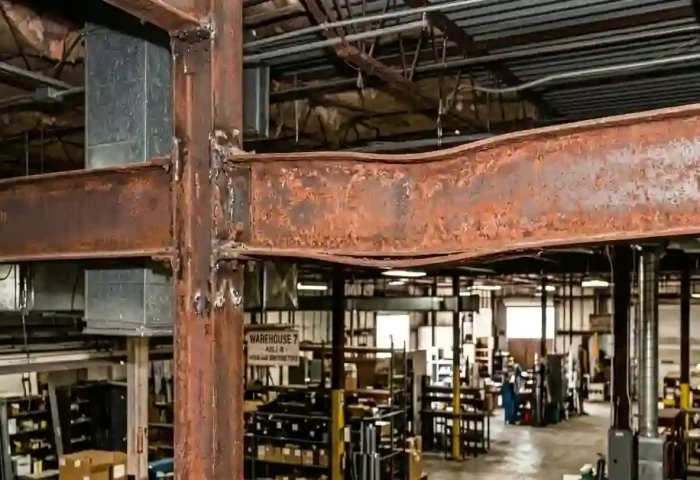
When we come out for an inspection which is always free — we’re looking at six things: deflection measurement (compared to AISC 360 limits), corrosion index rating, weld integrity at all visible connections, flange and web condition, load history, and any secondary members that may have been affected.
You get a written report with findings, photos, recommended scope, and an itemized cost estimate. Kevin H. described working with us this way in his Google review: “Shane is an amazing contractor.” That’s the straightforward, no-surprise approach we bring to every job.
For more detail on how we handle the full repair process once damage is confirmed, see our I-beam repair in Houston service page. If you’d like to understand what a full building structural inspection covers beyond just a single beam, that page walks through our complete assessment process for Greater Houston buildings.
Frequently Asked Questions
How do I know if my I-beam is bent or just painted unevenly?
Sight down the length of the beam from one end — it should appear perfectly straight. Any curve or bow in the web is deflection, not a surface issue. If you’re not sure, have a professional measure it against AISC deflection limits. Surface paint irregularities don’t follow the beam’s structural line the way true deflection does.
Can I-beam damage cause a building to collapse?
In extreme cases, yes — but collapse is rarely sudden. More commonly, progressive damage leads to partial failures: a roofline that sags, a connection that separates, or a floor section that becomes unsafe. The risk of collapse increases sharply when multiple beams are compromised or when damage is in a primary load-carrying member. That’s why catching signs of I-beam damage in Houston early is so important.
Are signs of I-beam damage covered by insurance in Houston?
Storm-related I-beam damage from Hurricane Harvey, tornados, hail, or wind events is typically covered under commercial property insurance. Corrosion and wear are generally not. We provide detailed photo documentation and written damage assessments that work directly with insurance adjusters, which can make a significant difference in your claim outcome.
How much does an I-beam inspection cost in Houston?
We provide free on-site structural inspections across Greater Houston including Harris County, Katy TX, Sugar Land TX, The Woodlands TX, Pearland TX, Pasadena TX, Baytown TX, Conroe TX, Humble TX, Spring TX, Cypress TX, Tomball TX, League City TX, and Richmond TX. The inspection includes a written report and itemized repair estimate at no charge.
Get a Free I-Beam Inspection — Same Day Available
Don’t wait for a small problem to become a structural emergency. If you’ve spotted any of the warning signs above, or if it’s been more than a year since your building was inspected, call us now at (832) 506-1574 or email estimate@houstonbuildingrepair.com. We serve all of Greater Houston and Harris County, and we respond same day for urgent situations.
Houston Building Repair Company — licensed and insured in Texas, 5.0 Google rating, 500+ structural repair projects completed across the Houston metro.